
Why Advisor Income Feels Unstable Early in Your Career

Advisor income variability in the early stages of a financial advisory career is not a sign that something is going wrong. It is a structural characteristic of how advisor income is generated.
Unlike salaried roles where compensation is fixed and predictable, financial advisors build income through client relationships, sales cycles, and long-term value creation. Each of these components takes time to develop, which creates a natural gap between effort and income in the first one to two years.
For new advisors, this gap can feel discouraging when it is not properly understood. Those who recognize advisor income variability as part of the process are far more likely to stay consistent long enough to reach income stability.
The Core Drivers of Advisor Income Variability
Advisor income variability is driven by a small number of underlying factors that affect when income is earned and how consistent it becomes over time. These factors apply across financial advising, insurance, and other client-based careers, but they are especially visible in the early years of an advisory practice.
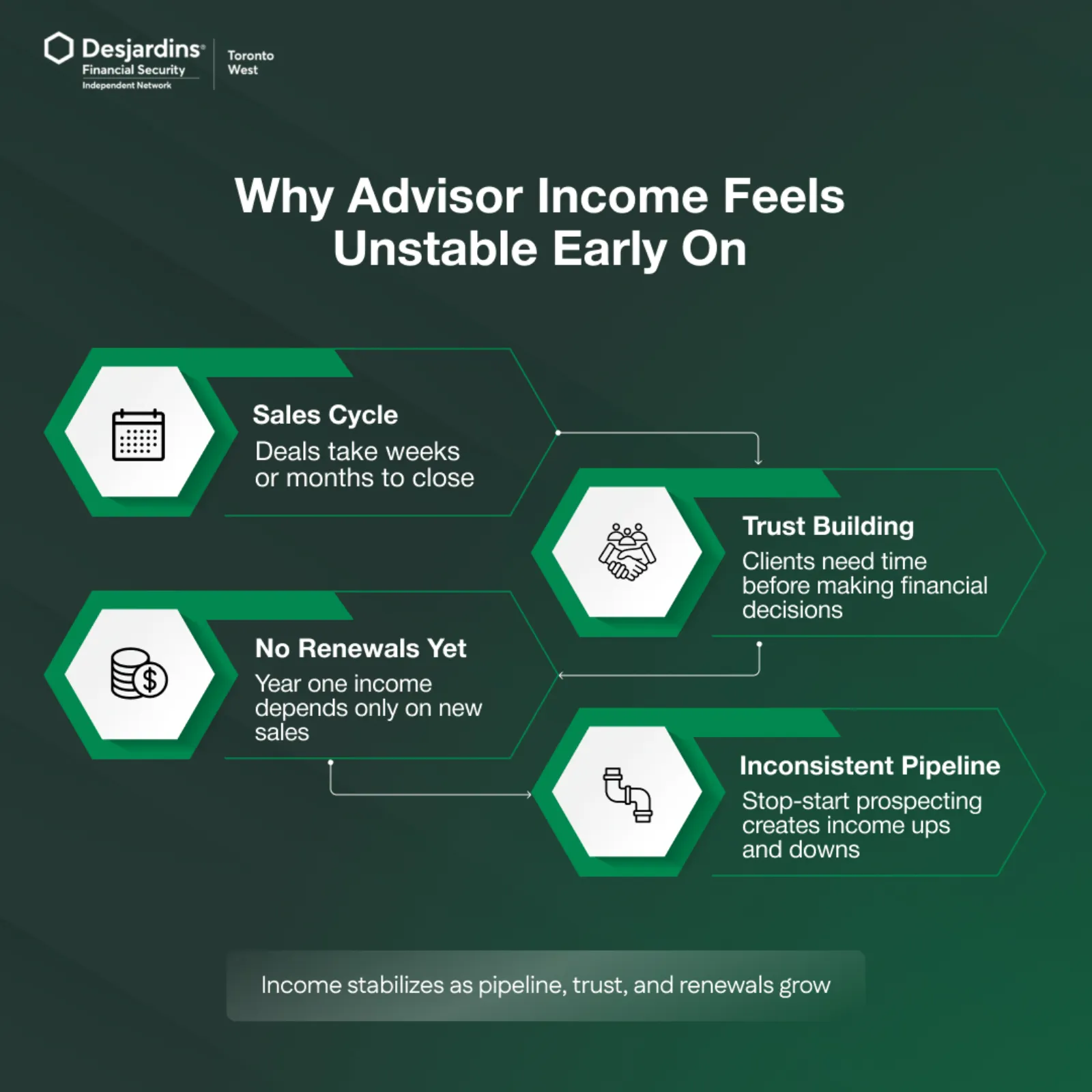
The image above illustrates four core drivers that work together to create income instability in the early career. Each one is examined in detail below.
Sales Cycle Timing Realities in Financial Advising
Sales cycle timing is one of the most important contributors to advisor income variability because income is always delayed relative to effort. Financial advisors are not selling impulse purchases. They are guiding clients through decisions related to life insurance, investments, and long-term financial planning. These decisions require time, consideration, and multiple conversations before any commitment is made.
Why Timing Delays Income
- Clients often evaluate multiple options before committing to any one product or advisor.
- Financial decisions commonly involve family input or external advice, extending the timeline beyond the advisor’s control.
- Documentation, underwriting, and compliance processes add additional steps between agreement and policy activation.
- Even interested prospects may take weeks to months before moving forward, which means activity completed today often produces no visible income until the following quarter.
Why Early Pipelines Produce Uneven Revenue
A new financial advisor’s pipeline is small and underdeveloped, which naturally leads to uneven income. Established advisors benefit from client diversification across pipeline stages, and deals close across multiple months at once. New advisors do not yet have that spread. For context on how this differs from a fully developed practice.
- Limited active prospects: Fewer opportunities mean each lost deal has a disproportionate impact on income for that month.
- No stage diversification: Deals cluster in one time period because the pipeline started at roughly the same time.
- Low conversion momentum: Early relationships have not yet matured to the point where referrals and repeat business contribute alongside new acquisitions.
How Activity Level Shapes Income Timing
- Higher prospecting volume creates overlap: Multiple deals progress simultaneously, which smooths income by ensuring cases close across different months rather than all at once.
- Consistent follow-up increases conversion rates: Opportunities are less likely to stall when follow-up is disciplined and timed correctly.
- Regular outreach builds future income: Today’s prospecting activity determines income availability three months from now, not tomorrow.
Client Trust Development and Its Impact on Income
Trust development is another major factor that influences advisor income variability, and it cannot be accelerated through effort alone. Clients need time to feel confident in both the advisor and the product recommendation. Higher-value financial decisions require deeper levels of trust, and many prospects delay action until they feel fully informed and comfortable with the person advising them.
What Trust Actually Delays
- Initial client commitments: A prospect who expresses interest in month one may not be ready to sign until month four or five. This is not hesitation. It is how financial trust works.
- Higher-value product decisions: Whole life insurance, disability coverage, and investment plans require clients to disclose detailed personal and financial information. Clients who are not yet confident in their advisor defer these conversations, limiting access to higher-commission products.
- Referrals and introductions: Referrals, typically the highest-quality and lowest-cost form of client acquisition, only flow from clients who trust their advisor enough to attach their own name to the recommendation. New advisors should expect this income stream to be negligible for the first twelve to eighteen months.
What Accelerates Trust Development
- Ongoing communication before and after the sale: Advisors who schedule regular check-ins, follow up after policy anniversaries, and send relevant updates build a presence that compounds trust. Those who only contact clients when a sale opportunity arises do not.
- Transparency about product limitations: Advisors who are honest about what a product does and does not cover, rather than overselling to close a case, build a reputation that generates referrals and repeat business far faster over time.
- Long-term client focus over short-term conversion: Clients sense when an advisor is focused on their outcomes rather than on commission. That perception drives trust faster than any follow-up script.

The Role of Renewal Income in Stabilizing Advisor Earnings
Renewal income is one of the most important factors in reducing advisor income variability over time, and its absence in the early career is one of the least-discussed reasons why income feels so unpredictable. In insurance-based advisory practices, a portion of a mature advisor’s income comes from annual or monthly renewal commissions on policies placed in prior years. A new advisor has no prior book, so they have no renewal income at all.
Early Career Reality vs. Mature Practice
- Year one is 100% production-dependent: Every dollar earned comes from new sales. There is no recurring baseline to absorb a slow prospecting month.
- No buffer for low-activity periods: A seasoned advisor with an established book can afford a quiet month because renewals continue regardless of new sales. A new advisor cannot.
- Each month starts from zero: Without renewal income, there is no built-in floor to income. Month-to-month variability is at its highest when the book is smallest.
How Renewal Income Changes the Math Over Time
- Years 2 and 3: a floor begins to form: As the client base grows and policies renew, a portion of monthly income becomes predictable regardless of new sales volume.
- Client retention protects the renewal base: Client retention data shows that roughly 20% of clients leave their advisor within the first year. Advisors who prioritize correct product placement and ongoing communication protect the renewal base they are beginning to build.
- Renewal income reduces prospecting pressure over time: Once renewal income covers a portion of monthly expenses, new advisors can prospect from a position of stability rather than urgency.
How to Manage the Renewal Lag Period
- Build a personal cash reserve before launching: Advisors who enter the field with three to six months of personal expenses saved are far less likely to exit during the variability phase, because they can sustain activity levels without financial pressure forcing premature decisions.
- Prioritize correct product placement from day one: Placing the right product for each client, rather than the easiest sell, reduces early lapse rates and protects the renewal income that makes the variability of year one worth enduring.
Pipeline Consistency and the Stop-Start Problem
Pipeline consistency is the operational challenge that sits beneath all the structural factors driving advisor income variability. Most new advisors focus intensely on prospecting when their pipeline is empty, then stop prospecting when they are busy closing. That pattern creates the boom-and-bust income cycle that defines early advisor income variability.
Why the Stop-Start Cycle Persists
- Closing cases consumes prospecting time: When a new advisor is in meeting-heavy closing weeks, prospecting calls and outreach drop to near zero. The pipeline that will feed income three months later is not being filled, while the current income looks healthy.
- Urgency-driven prospecting creates uneven input: Advisors who only prospect when income drops tend to overwork in low months and underwork in strong months, creating an irregular input pattern that produces equally irregular output.
- Without CRM tracking, pipeline health is invisible: Advisors who do not track prospect stages often believe their pipeline is healthy because they are busy, when in fact activity has been concentrated in closing rather than top-of-funnel development.
What Creates Pipeline Consistency
- A fixed weekly prospecting schedule: Advisors who protect a specific block of prospecting time each week, regardless of how busy their calendar is with client meetings, maintain a more consistent pipeline and experience significantly less income variability over a twelve-month period.
- CRM tracking of prospect stage and follow-up dates: A CRM system that shows exactly how many prospects are at each stage at any given time removes guesswork from prospecting decisions and makes the connection between current activity and future income visible in real time.
- Mentorship accountability for pipeline reviews: New advisors who review their pipeline with a mentor or manager weekly are more consistent prospectors than those operating independently, because external accountability creates structure that early-career discipline alone rarely maintains.
Expectation Alignment for New Financial Advisors
Expectation alignment separates new advisors who weather the income variability period from those who exit before their pipeline matures. The industry data on this is stark: according to Cerulli Associates, nearly 71% of new advisors drop out within five years, with the majority exiting in the first three years. Most of these exits happen not because the advisor lacked skill, but because their income expectations did not match the structural reality of how advisory income develops.
What Realistic Income Timelines Look Like
- Months one to six are the hardest: High activity with limited visible income. This is the most discouraging phase and also the most important one to endure. The pipeline being built now is what produces stability in year two.
- Months six to eighteen: gradual stabilization: Closings begin to appear more consistently as early prospects move through the sales cycle and trust deepens with initial clients.
- Year two and beyond: increasing predictability: Renewal income begins to contribute a baseline floor. Referrals from year-one clients start arriving. Prospecting activity produces faster results because the advisor’s reputation is beginning to work for them.
How Support Structures Change the Outcome
The advisors who make it through the income variability phase rarely do so alone. Structured support from a financial centre changes the timeline in measurable ways. Defined onboarding programs, lead generation support, and compliance infrastructure get new advisors to their first closed cases faster. Mentorship from experienced advisors compresses the learning curve on pipeline management and client communication.
- Structured onboarding reduces the time to first income: New advisors who join practices with defined training programs begin closing cases faster than those building from scratch, which shortens the most difficult phase of income variability.
- Mentorship provides accountability during low-income months: Regular access to experienced advisors, team-based case collaboration, and a culture that normalizes the early-career income curve are what sustain motivation when income is low and effort is high.
- Access to a team with diverse specializations: The ability to consult colleagues on complex cases accelerates trust-building with clients and expands the range of products a new advisor can confidently recommend early in their career.
From Advisor Income Variability to Income Stability
Advisor income variability in the early career is predictable and manageable once you understand what is driving it. The sales cycle takes time to produce consistent closings. Trust takes time to develop into referrals and complex product decisions. Renewal income does not exist in year one. Prospecting gaps in busy months create income gaps three months later.
None of that reflects poor effort. It reflects the mechanics of how an advisory practice is built. The advisors who reach income stability are those who stay consistent through the variability phase with the right expectations and the right support structure behind them.

Table of Content