
Advisor Autonomy in Financial Services

Advisor autonomy in financial services defines how much control a financial professional holds over daily decisions, client relationships, business operations, and career direction. It is a term that gets used broadly across advisory roles, but its actual meaning varies depending on the employment model, industry structure, and professional stage. Understanding what autonomy covers, how it differs from independence, and what trade-offs it carries helps advisors make accurate career assessments.
Key Takeaways
- Autonomy refers to control over decisions and daily practice, not ownership of the business or client relationships.
- Independence is a separate concept that includes legal business ownership, financial risk, and full accountability for compliance.
- Greater autonomy increases operational responsibility alongside long-term career value.
- The difference between autonomy and independence has direct consequences for career planning and risk exposure.
What Advisor Autonomy Means in Practice
Advisor autonomy refers to the degree of discretion a financial professional exercises across planning decisions, service delivery, and operational choices. It covers how advisors select financial products, structure client interactions, and manage their workflow. The level of control present in a given role shapes both daily execution and long-term professional outcomes.
Planning and Product Decisions
Advisors with higher autonomy determine which financial strategies to apply, which solutions to recommend, and how those recommendations are presented to clients. This discretion allows them to align plans with individual client needs and their own professional judgment. In lower-autonomy roles, these decisions fall within industry-approved frameworks that standardize outputs across an advisory team.
Client Experience and Service Design
Autonomy over client experience includes control of communication frequency, meeting formats, service tiers, and follow-up processes. Advisors who hold this discretion can align their service delivery with their professional standards and client expectations. Advisors in more structured environments follow standardized service models that the industry sets and maintains.
Operational Choices
Operational autonomy covers decisions about planning software, reporting systems, internal procedures, and workflow design. Advisors with this control select tools that match their working style and practice requirements. In centralized environments, these choices are made at the industry level, and advisors operate within assigned systems.
Autonomy as a Spectrum
Autonomy is not a binary state. Some advisors hold discretion only in client conversations, with everything else standardized by the industry. Others manage practices where nearly all decisions rest with them. Career stage, industry type, and role structure all determine where an advisor falls on this spectrum.
Effect on Professional Identity and Motivation
Advisors with greater decision control typically report stronger ownership over outcomes and client relationships. This accountability supports long-term engagement. Advisors working within structured environments benefit from established systems that reduce decision fatigue and clarify execution expectations.
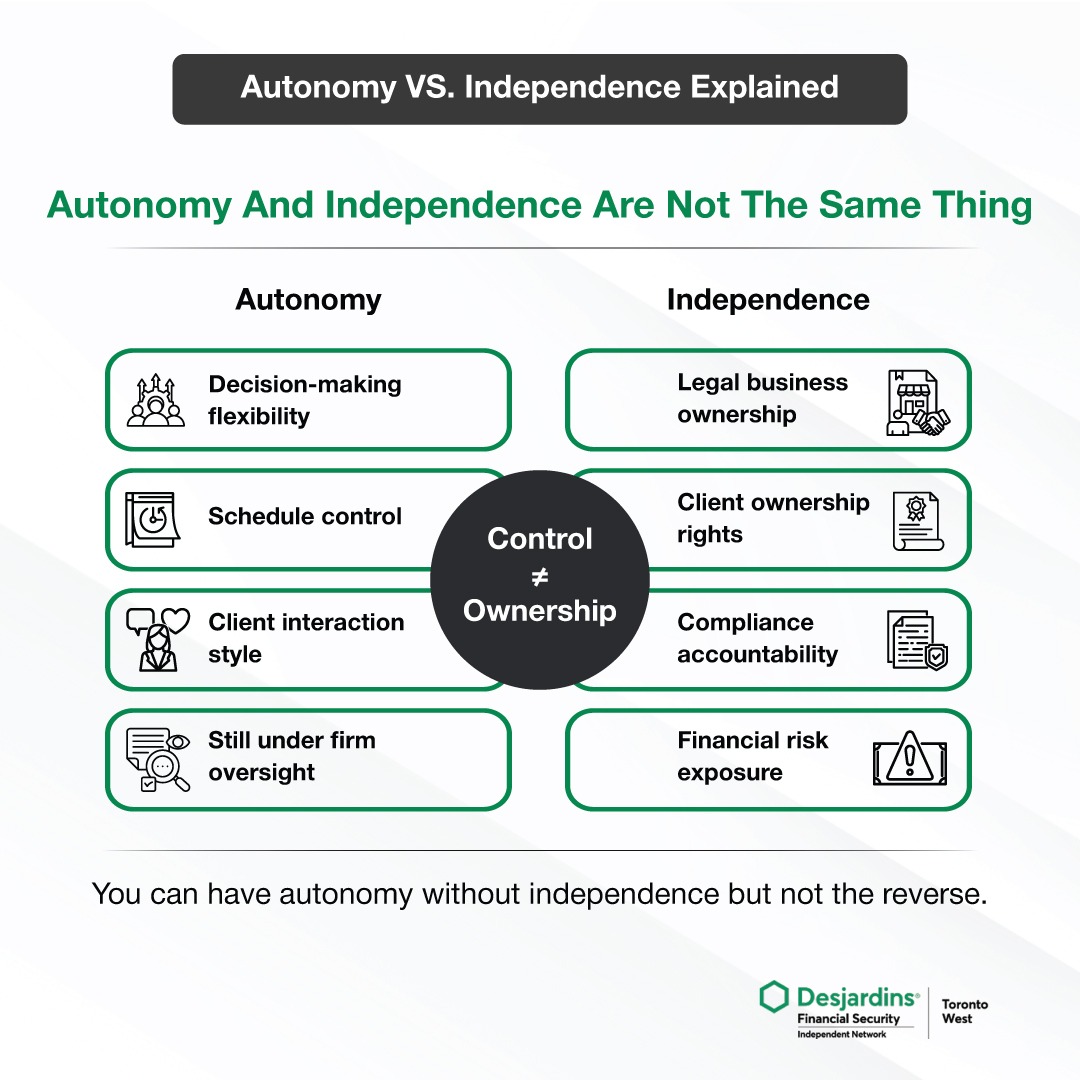
Autonomy and independence are distinct concepts. The financial services industry uses both terms, and conflating them produces inaccurate career expectations. Autonomy describes the degree of control an advisor has within an existing structure. Independence describes the legal and financial status of owning the business itself. The practical consequences of each are very different.
Autonomy Is About Control, Not Ownership
An advisor who operates with high autonomy makes independent decisions about how they work, how they serve clients, and how they manage their time. The industry still owns the advisory relationship from a legal and business standpoint. Compliance oversight, brand identity, liability protection, and operational infrastructure remain the industry’s responsibility. The advisor benefits from that structure while exercising personal discretion over execution.
A concrete example: an advisor at an industry who sets their own meeting schedule, selects how to position financial products, and designs their own client communication process has high autonomy. They do not, however, own the book of business. If they leave the industry, the client relationships stay with the industry unless contractual arrangements say otherwise.
Independence Is About Ownership and Accountability
An independent advisor owns the advisory practice. The business entity, the client relationships, the revenue, the liabilities, and the compliance accountability all belong to the advisor. There is no industry absorbing operational risk or regulatory exposure. The advisor makes every decision, including ones that go well beyond client planning, such as hiring staff, selecting regulatory structures, managing business expenses, and maintaining profitability.
Independence removes the industry’s infrastructure and replaces it with the advisor’s own. Client data, service agreements, and relationship continuity rest entirely with the advisor. When an independent advisor exits the business, they take the practice with them or transfer it at their discretion.
Why This Distinction Shapes Career Decisions
Advisors who want flexibility in how they work, without the obligations of business ownership, are describing a preference for autonomy within a structured industry. Advisors who want full control over client relationships, revenue streams, and practice direction are describing a preference for independence. These are different goals with different risk profiles and different qualification requirements.
Misidentifying one for the other leads to poor role selection. An advisor who joins an industry expecting independence, when the role offers high autonomy, will encounter structural constraints they did not anticipate. An advisor who builds an independent practice expecting it to feel like a high-autonomy corporate role will face ownership responsibilities they are not prepared for. Clarity on the distinction supports accurate career planning.
Decision-Making Authority in Practice
Decision authority determines how advisors serve clients and manage daily operations. Advisors with broader authority set planning approaches, select investment solutions, and customize service structures based on individual client situations.
Decision-making authority often includes:
- Selection of financial strategies aligned to client objectives and risk tolerance
- Choice of investment solutions matched to specific client profiles
- Customization of service models based on client complexity and engagement level
Advisors in lower-autonomy roles operate within industry-approved product lists and planning frameworks. These constraints simplify execution, reduce compliance risk, and maintain consistency across a team. The trade-off is reduced flexibility when a client’s situation falls outside standard parameters.
Advisors who value discretion over execution consistently report higher satisfaction in roles that carry broader decision authority. Advisors who prefer predictable systems and structured support perform well within more constrained environments.
Client Relationship Ownership
Client ownership is one of the most significant variables in advisory career planning, and it is directly connected to the distinction between autonomy and independence. Advisors who own client relationships hold the rights to communication, service continuity, and long-term planning direction. Advisors who work within industry-owned books of business do not.
Client ownership also determines what happens during career transitions. Advisors who own their book carry those relationships with them. Advisors operating under industry ownership typically rebuild from a new client base after a transition. Over a long career, this difference has significant consequences for enterprise value and compensation structure.
Operational Accountability
As advisor autonomy increases, so does operational accountability. Advisors who control their own practice manage compliance relationships, technology selection, staffing decisions, and expense oversight alongside their client-facing responsibilities.
- Managing regulatory reporting and dealer relationships
- Selecting and maintaining planning software and client management systems
- Overseeing business expenses and monitoring practice profitability
In structured industry environments, these responsibilities rest with centralized operations teams. Advisors focus on client work. The industry manages everything else. This model supports consistency and reduces the administrative burden on individual advisors, at the cost of control over how those operations function.
Advisors assessing readiness for greater autonomy should evaluate their capacity for operational management alongside their advisory competency. Business management demands grow proportionally with the degree of autonomy held.

Trade-Offs Advisors Accept with Greater Autonomy
Higher autonomy comes with a corresponding increase in responsibility. Advisors who gain control over decisions, operations, and client relationships also absorb the accountability that structured environments distribute across teams and industry infrastructure.
- Greater personal responsibility for compliance oversight and regulatory adherence
- Variable income tied directly to retention, performance, and business development
- Long-term compensation growth that builds over time rather than from a fixed base salary
Structured roles distribute these pressures across the industry. Advisors in those environments benefit from predictable support systems and stable income frameworks. Career value develops through different mechanisms, typically through demonstrated expertise and client retention within industry-controlled books.
The decision to pursue greater autonomy requires an honest assessment of comfort with accountability, capacity for operational management, and tolerance for income variability in the early stages of practice development.
Frequently Asked Questions
What is the practical difference between an autonomous advisor and an independent advisor?
An autonomous advisor makes independent decisions about how they serve clients and run their daily practice, but operates within an industry structure where the business entity, client book, and compliance accountability belong to the industry. An independent advisor owns the practice outright. The business registration, client relationships, regulatory obligations, and financial risk all belong to the advisor personally. The autonomous advisor has discretion over execution. The independent advisor has ownership over everything.
Can an advisor have high autonomy without being independent?
Yes. Many advisors working within large financial services industries hold significant discretion over planning approaches, client communication, and service design without owning the business or the client book. Industry’s structure these arrangements to retain talent and improve client outcomes while maintaining industry-level oversight of compliance, branding, and infrastructure. The advisor gains operational flexibility. The industry retains ownership of the assets and regulatory responsibility.
How does client ownership affect an advisor’s long-term career value?
Client ownership is a primary driver of advisory practice value over a career. Advisors who hold contractual rights to their book of business accumulate enterprise value that can be monetized through a sale, succession arrangement, or partnership agreement. Advisors without client ownership do not build this asset. When they leave an industry, they start over. Over a 20 to 30-year career, the financial difference between owning and not owning a book of business is substantial.
Does higher autonomy increase career risk?
Higher autonomy increases responsibility and operational exposure, which carries risk if not managed with discipline. Advisors who take on greater autonomy without the planning habits, compliance knowledge, and business management skills to support it face income instability and regulatory exposure. Advisors who build those competencies before expanding their autonomy typically manage the transition successfully. Risk is proportional to preparation, not autonomy itself.
Who is best suited to autonomous advisory roles?
Advisors who perform well in autonomous roles typically combine strong client relationship skills with comfort in operational decision-making and accountability for business outcomes. They are comfortable with variable income, disciplined about long-term practice development, and capable of managing compliance and administrative responsibilities independently. Advisors who prefer structured support, predictable workflows, and industry-managed compliance typically perform better within structured employment models.
How does autonomy affect client outcomes?
Advisors with broader decision-making authority can tailor planning strategies, service models, and communication approaches to the specific needs of each client. This flexibility supports more individualized financial planning. The quality of outcomes still depends on the advisor’s competency and consistency. Autonomy creates the conditions for personalization, but does not produce better outcomes on its own.
Advisor Autonomy and Long-Term Career Direction
Autonomy is a structural condition that defines how much control a financial professional holds over their practice, their decisions, and their client relationships. It is not the same as independence, and treating the two as equivalent produces inaccurate career expectations. Advisors who evaluate their tolerance for responsibility, preference for operational control, and capacity for business management make more accurate decisions about which advisory structures align with their professional goals. The distinction between autonomy and independence, the role of client ownership, and the accountability that comes with operational control are the practical variables that shape long-term advisory career outcomes.

Table of Content