
Captive vs Independent Financial Advisor Models

The captive vs independent financial advisor comparison explains how two advisory models operate, how advisors work within each structure, and how those differences shape client outcomes and career paths. This article outlines how captive advisor models are built, how product access works, how client relationships are managed, and how operational freedom compares with responsibility. You will also see how career ownership, income control, and risk tolerance influence long-term success. The goal is clarity, not persuasion, so you can assess which model aligns with professional priorities and planning philosophy.
Key Takeaways
- Captive and independent advisor models differ in structure, product access, and decision authority.
- Control over client relationships, platforms, and operations shapes long-term career ownership.
- Risk tolerance and responsibility levels play a major role in choosing the right advisory path.
Understanding the Captive Financial Advisor Model
A captive financial advisor operates within a single financial institution, insurance company, or brokerage firm. The firm provides infrastructure, branding, training, compliance oversight, and approved product access. Advisors work under the organization’s umbrella, following defined processes and sales frameworks.
This structure emphasizes stability and consistency. Advisors receive guidance, tools, and support that reduce administrative workload. Many professionals enter the industry through captive models due to structured onboarding and predictable systems.
How Captive Advisor Models Are Structured
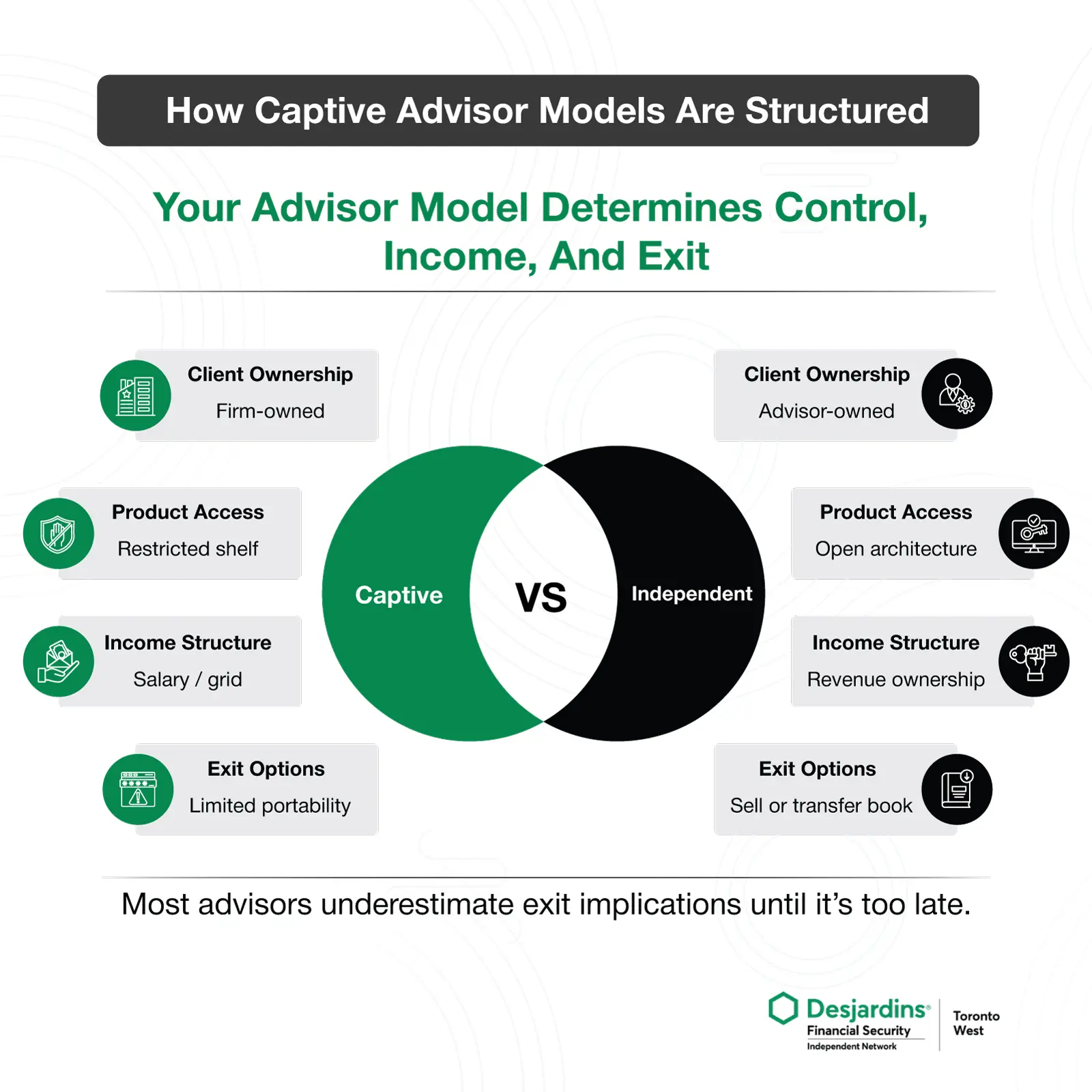
Captive advisors represent one firm and operate under its regulatory license. The firm controls branding, approved platforms, marketing guidelines, and operational standards. Advisors follow defined workflows that simplify compliance and reporting.
This structure reduces complexity for advisors early in their careers. Systems are already in place, which shortens the learning curve. Advisors focus more on client conversations and less on backend operations.
Product and Platform Restrictions
Captive advisors offer products approved by their firm. Investment options, insurance solutions, and planning tools come from an internal lineup. This creates consistency across the advisor network.
Restrictions also limit flexibility. Advisors work within preset offerings, which may reduce customization. Clients receive solutions that fit the firm’s framework rather than a broad marketplace.
Control Over Client Relationships
Client relationships often belong to the firm rather than the advisor. Client data, records, and contracts remain with the institution. Advisors manage relationships while employed by the firm.
This arrangement offers stability yet limits portability. If an advisor leaves, clients typically remain with the firm. Career transitions require rebuilding client relationships from the beginning.

Understanding the Independent Financial Advisor Model
An independent financial advisor operates outside a single institutional framework. Advisors select platforms, custodians, products, and technology partners based on personal strategy and client needs. This model emphasizes autonomy and customization.
Independent advisors run their practice as a business. They manage branding, compliance partnerships, technology choices, and operational processes. This structure rewards initiative and long-term planning.
Operational Freedom Versus Responsibility
Independent advisors control how their practice operates. They select planning tools, investment platforms, and service partners. This flexibility supports tailored client solutions.
Responsibility increases alongside freedom. Advisors manage expenses, compliance relationships, marketing, and operations. Success depends on business management skills alongside advisory expertise.
Career Ownership Implications
Independent advisors own their client relationships. Client records, service models, and branding belong to the advisor’s practice. This ownership creates long-term enterprise value.
Practices can be grown, transitioned, or sold. Advisors build equity over time through recurring revenue and client loyalty. Career value extends beyond annual income.
Risk Tolerance Considerations in Advisor Models
Risk tolerance shapes career direction in the same way it shapes investment strategy. Advisors face different types of exposure depending on structure, compensation design, and ownership level. Understanding where risk sits helps you choose a model that supports both professional performance and personal comfort.
- Income predictability: captive models often include base compensation, training stipends, and structured incentives that reduce short-term income swings.
- Operational exposure: centralized systems in captive environments limit responsibility for compliance, technology, and administrative costs.
- Business responsibility: independent models place financial accountability directly on the advisor, including expenses, staffing, and operational decisions.
- Revenue variability: independent income depends on client growth, retention rates, pricing discipline, and expense control rather than fixed compensation.
- Decision authority: independence increases control over services, platforms, and pricing, which introduces opportunity alongside responsibility.
- Long-term value creation: independent practices create enterprise value through client ownership and recurring revenue rather than employment tenure.
- Stress tolerance: advisors with comfort managing uncertainty often adapt more easily to independent environments with fluctuating revenue patterns.
- Planning discipline: success in independent models relies on strong forecasting, budgeting, and long-range planning habits.
Choosing between a captive vs independent financial advisor path requires honest self-assessment. Your comfort with responsibility, uncertainty, and delayed rewards matters as much as technical knowledge. Advisors who align career structure with personal risk tolerance tend to maintain consistency, confidence, and long-term satisfaction.
Comparing Long-Term Career Outcomes
Career progression differs significantly across models. Captive advisors advance through internal ranks, leadership tracks, and regional management roles. Growth depends on firm-defined benchmarks and performance metrics.
Independent advisors grow through client acquisition, referral networks, and service expansion. Income scales with business performance. Advisors control pricing, service scope, and growth strategy.
The captive vs independent financial advisor discussion centers on control versus structure. Each path offers valid advantages depending on career priorities.
FAQ
How to evaluate the right model
Start by assessing how much operational responsibility you want to manage. Review income expectations, client ownership rules, and platform flexibility. Compare training support with long-term earning potential. Choose the model that aligns with professional goals and risk comfort.
Which model offers stronger income stability
Captive models often provide steadier early income through structured compensation. Independent income fluctuates based on business performance. Stability grows over time for independent advisors as client bases mature. Income predictability depends on planning discipline.
Does independence improve client outcomes?
Independence allows broader product access and customized planning. Advisors can select solutions based on client needs rather than firm restrictions. Client experience improves when advisors control service design. Results depend on advisor competence and systems.
The captive vs independent financial advisor decision shapes how advisors build careers, serve clients, and manage risk. Structure supports stability while independence supports ownership. Each model suits different professional priorities. Clear evaluation leads to confident decisions.
Evaluating Advisor Models With Clarity
Choosing between captive vs independent financial advisor models requires clarity around control, responsibility, and long-term vision. Captive paths provide structure, support, and predictable systems. Independent paths reward ownership, flexibility, and enterprise value. Career satisfaction depends on how well the model matches risk tolerance, business mindset, and client service philosophy. Advisors who understand these differences make decisions with confidence rather than pressure. A thoughtful comparison helps build a career that supports both professional growth and client trust.