
How Financial Advisor Compensation Works in Canada

Financial advisor compensation in Canada operates through several distinct models, and the one an advisor works under shapes how quickly, how predictably, and how sustainably their income grows over time. Unlike salaried professions, where pay is fixed and determined by job title, most financial advisory roles in Canada tie compensation directly to client relationships, assets managed, or advice delivered. Each of those structures creates a different income experience across the career arc.
For anyone considering entering the profession or evaluating their current structure, understanding what each compensation model actually means in practice is more useful than any single salary figure. Income potential, income variability, and the long-term asset value of a book of business all depend on which model an advisor operates under and how well they understand its mechanics.
Core Compensation Structures in Canada
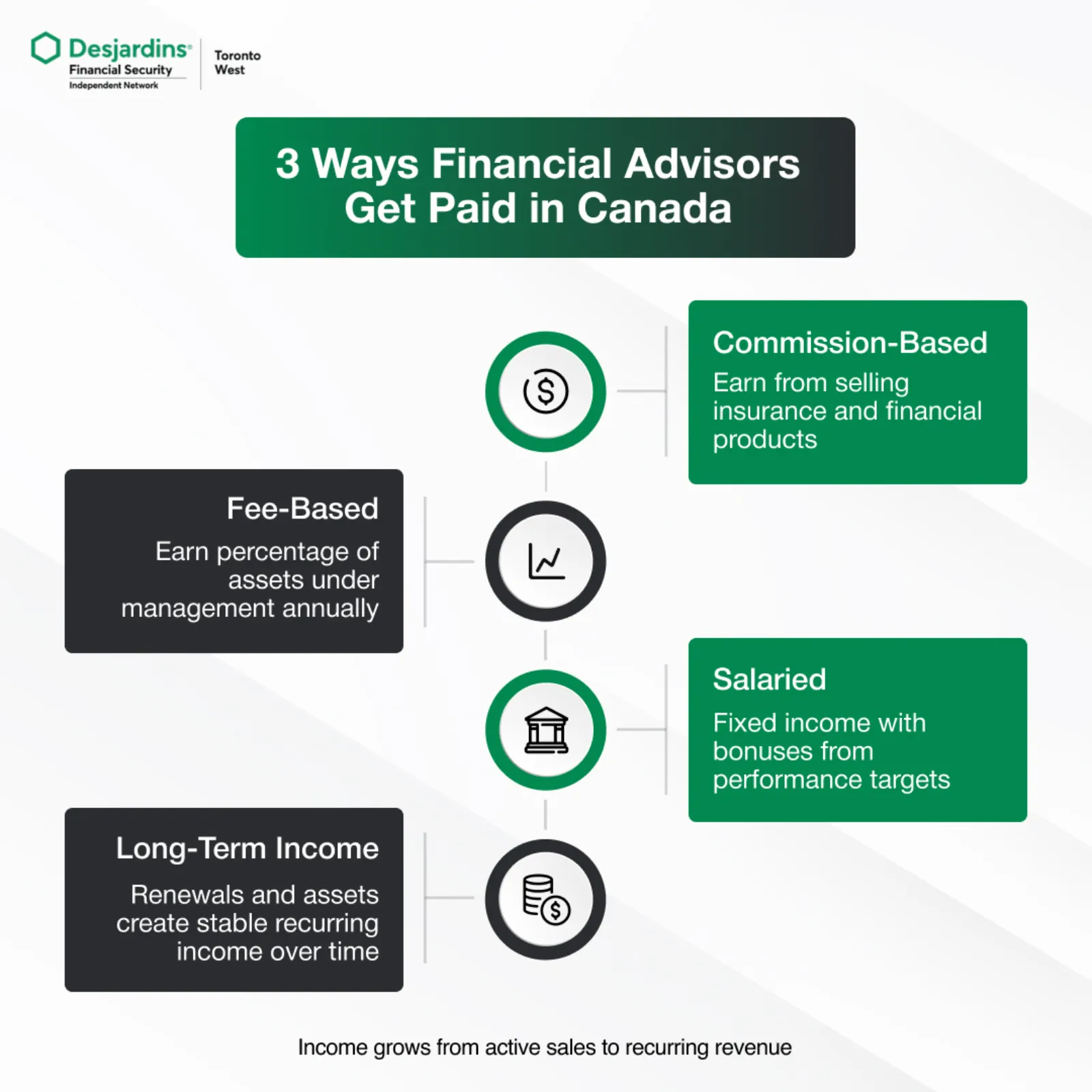
Financial advisor compensation in Canada breaks into three primary structures: commission-based, fee-based, and salaried. Commission-based compensation dominates the insurance and independent advisory space. Fee-based compensation is common among investment advisors and wealth managers. Salaried compensation is typical at bank branches and credit unions. Each structure creates different incentives around how, when, and what an advisor recommends to clients.
Commission-Based Compensation
- Income is tied directly to product sales: A commission-based advisor earns money when a client purchases a financial product such as a life insurance policy, a segregated fund, or an annuity, with no floor income and no guaranteed pay between closings.
- The model rewards production volume and product diversity: Advisors who work across both insurance and investment products can build multiple commission streams simultaneously, which reduces dependence on any single product category and stabilizes income over time.
- Long-term income compounds through renewal commissions: Once policies are placed, renewal commissions arrive each year a client maintains coverage, creating a recurring income base that grows as the book of business grows.
Fee-Based Compensation
- Income is tied to assets under management: Fee-based advisors charge a percentage of the assets they manage, typically between 0.5% and 1.5% annually. Income grows as client portfolios grow and contracts during market downturns.
- Advisor and client interests are more directly aligned: Because fee-based financial advisor compensation rises as client assets increase, advisors in this model are structurally incentivized to grow portfolios rather than generate transaction activity.
- Flat and hourly fee structures also exist: Independent financial planners often charge directly for advice delivered, whether a comprehensive financial plan, a retirement projection, or a tax optimization review, with the fee agreed before the work begins.
Salaried Compensation
- Income is fixed and predictable from day one: Salaried advisors at banks and credit unions receive a base salary plus a performance bonus, which provides income stability during the early career period that commission-based advisors do not have.
- The income ceiling is lower: While a bank salary removes early-career income risk, it also caps upside. The highest-earning financial advisors in Canada are consistently found in commission-based and fee-based roles, not in salaried bank positions.
- No book of business is built: Salaried advisors work with the employer’s client base, not their own. When they leave, they take no clients, no renewal income, and no saleable asset with them.
Commission-Based Earnings Explained
Commission-based financial advisor compensation is the dominant model in the insurance-focused advisory space. It works through two distinct income streams: first-year commissions paid when a new policy is placed, and renewal commissions paid in subsequent years when the client’s policy remains active. The financial advisor training programs at DFSIN Toronto West prepare new advisors for both the opportunity and the income variability this structure creates, with practical coaching on pipeline management, prospecting discipline, and client retention as the core pillars of a sustainable practice.
First-Year Commissions
- The highest single-period earning event in the insurance model: A life insurance policy placed in year one can generate a commission equal to 100% of the first-year premium. A policy with a $5,000 annual premium produces $5,000 in advisor income at placement.
- First-year commissions reward new business volume: Advisors who consistently place new policies earn their highest per-case commissions in year one. Production volume during the early career phase is therefore the primary driver of income for new advisors.
- Income in year one is entirely production-dependent: Without renewal income yet, every dollar earned requires a new sale. This is why the first twelve months produce the highest income variability in a commission-based career.
Renewal Commissions
- The foundation of long-term income stability: Once a policy is placed, the advisor earns a renewal commission each year the client maintains coverage, typically 2% to 5% of the annual premium. This recurring income stream grows as the book of business grows.
- Renewal income accumulates into a income floor: An advisor with 300 active policies generating an average of $3,000 per policy in annual premium earns relevant renewal income independent of how many new cases they place that month. That floor is what commission-based advisors are building toward from day one.
- Policy lapses erode the renewal base: When a client cancels their policy, the advisor loses that renewal commission for every future year. Persistency, the percentage of placed policies still active after twelve months, is one of the most important metrics in managing long-term financial advisor compensation.

Service and Advisory Income Models
Service and advisory income models cover both the assets-under-management fee structure used by investment advisors and the flat or hourly fee structures used by independent financial planners. According to MoneySense (2025), almost half of Canadian investors did not know how much they paid their advisor directly or indirectly in the past twelve months, which reflects how opaque the current fee environment is and why transparent, value-linked service models increasingly stand out.
Assets Under Management Fees
- Income scales directly with client portfolio size: An advisor managing $5 million in assets at a 0.5% annual fee earns $25,000 from that single relationship annually. That income grows every year the portfolio grows, without any additional transaction or policy placement required.
- AUM fees create a strong client retention incentive: Because AUM-based advisor compensation depends on clients maintaining their assets under management, advisors in this model are strongly motivated to deliver ongoing value and prevent assets from moving to competitors.
- Income is subject to market fluctuations: When markets fall, client portfolios shrink, and so does AUM-based income. This is one key difference from renewal commission income, which persists regardless of market performance as long as policies remain active.
Flat and Hourly Fee Structures
- Income is tied to advice delivery, not product outcome: Flat-fee and hourly advisors charge directly for the planning work they perform, with the fee agreed before the work begins.
- Most common for time-limited or one-time engagements: Clients who need specific advice rather than ongoing portfolio management often engage flat-fee advisors, making this income stream more transactional than the recurring renewal or AUM models.
- Growing in relevance as transparency expectations rise: As clients become more aware of implicit costs embedded in commission and AUM structures, demand for flat-fee advice is growing among Canadians who want a clear, fixed cost for planning services.
Income Variability Across Compensation Models
Income variability is a feature of financial advisor compensation in Canada that affects commission-based advisors most acutely and fee-based advisors to a lesser degree. Understanding what drives variability, and how to plan for it, is one of the most practical pieces of knowledge a new advisor can develop before they start. The factors that create variability in year one are largely structural and predictable rather than random or personal.
The four factors illustrated below work together to create income instability in the early career. Each one is addressable over time, but all four are present to some degree in every new commission-based practice.
Production Volume and Pipeline Consistency
- New case volume is the primary driver of first-year income: An advisor who closes five cases in a month earns commission on five cases. The following month, if they close two, income falls proportionally. This direct relationship means year-one compensation is highly responsive to weekly activity levels.
- Pipeline gaps create income gaps three months later: Prospecting activity done today typically closes two to four months from now. A slow prospecting month does not appear as a slow income month until the following quarter, which is why the problem is often not recognized until it is already underway.
- Consistent prospecting is the single most controllable variable: Advisors who protect a fixed weekly prospecting block, regardless of how busy their client calendar is, maintain a more consistent pipeline and experience significantly less income variability over any twelve-month window.
Client Retention and Lapse Rates
- Policy lapses directly reduce renewal income: Each cancellation removes a recurring income stream from the advisor’s book. Advisors who place well-matched products and maintain regular client contact typically achieve higher persistency rates than those who optimize for short-term conversion at the expense of product fit.
- High lapse rates delay income stabilization: Advisors who see frequent early cancellations extend the income variability period because the renewal base they are trying to build is eroding faster than new placements can replace it.
Trust Development and Sales Cycle Timing
Two additional drivers of early-career income variability are trust development and sales cycle timing. These are covered in detail in the related article on advisor income variability, but the core point is this: income does not appear immediately after effort is applied.
Financial decisions require time, multiple conversations, and a level of client trust that builds over months, not days. New advisors who understand this timeline in advance are significantly better positioned to stay consistent through the variability phase.
Stability vs. Volatility Across Compensation Models
The stability-to-volatility ratio of financial advisor compensation in Canada varies significantly depending on which model an advisor operates under and how far along they are in building their client base. No model is inherently superior across all situations. Each one involves tradeoffs between early-career security and long-term earning potential.
Why New Commission Advisors Experience High Volatility
- No renewal base in year one means 100% production dependency: A new advisor entering a commission-based practice earns nothing from prior business because there is no prior business. Every dollar in year one requires a new sale.
- The income floor rises each year as the renewal base grows: According to ERI SalaryExpert, the average entry-level financial advisor in Canada earns $54,340 annually, rising to $108,610 at the senior level, with a projected 13% income increase over five years. These figures reflect the income trajectory of advisors who maintain their renewal base and grow their production consistently.
- Salaried advisors have stability but trade it for ceiling: Bank-based advisors avoid early-career income risk entirely, but they also do not build personal books or renewal streams, which means their compensation growth is tied to job title progression rather than business development.
When Income Stabilizes for Commission Advisors
- Years two and three mark the transition from volatility to stability: By the time an advisor has placed policies with 150 to 200 clients and maintained strong retention, renewal income provides a relevant monthly baseline that makes total compensation significantly less dependent on any single week’s new closings.
- Fee-based advisors stabilize faster but grow more slowly: Because AUM fees are recurring from the moment an initial client base is built, fee-based advisors reach income predictability sooner, but their growth is limited by market returns rather than their own production capacity.
Long-Term Income Considerations
Long-term financial advisor compensation in Canada in a commission-based practice goes beyond monthly earnings. It includes the value of the book of business itself. A well-maintained book of insurance policies generates renewable income indefinitely, and independent producers can sell their books for two to two-and-a-half times annual revenues when they retire.
The Book of Business as an Asset
- Renewal income continues regardless of active prospecting: An advisor who steps back from active new business development but maintains existing client relationships continues to earn renewal commissions on every active policy. A mature book can generate income that funds a gradual transition toward retirement.
- Book value is typically two to two-and-a-half times annual renewal revenue: A book generating $100,000 in annual renewal commissions carries a market value of approximately $200,000 to $250,000 when sold. This is a retirement asset that advisors in salaried roles do not build.
- Succession and inheritance options add further value: Independent advisors in networks like DFSIN have access to support for buying, selling, and transferring books of business, which creates planning options that do not exist for advisors working under bank employment agreements.
How Income Grows Through the Career Turn Point
- Growth through accumulation, not promotion: Unlike a salaried career where income rises through job title advancement, commission-based financial advisor compensation grows by accumulating more active clients, placing higher-premium products, and maintaining strong retention. These three factors compound each other over time.
- Designations increase earning capacity and credibility: Advisors who complete designations such as the Certified Financial Planner (CFP) or Chartered Life Underwriter (CLU) access more complex client conversations, higher-value cases, and in some structures, higher commission grid levels, increasing their income ceiling compared to undesignated advisors.
- Referrals become a compounding income driver over time: As a book matures and clients trust their advisor, referral-based acquisition reduces prospecting costs while increasing the quality of incoming prospects. This shift from cold outreach to referral-driven growth is one of the most significant inflection points in a commission-based career.

Choose the Right Model and Build Toward the Income You Want
Financial advisor compensation in Canada rewards the advisors who understand their model deeply enough to work with its mechanics rather than against them. The compensation model is not the only variable that determines whether an advisor succeeds, but it is the structural context in which everything else happens. Choosing a model that aligns with your financial situation, your risk tolerance, and your long-term income goals is one of the most consequential decisions a new advisor makes.
Table of Content